
Robert Szustkowski conducts legal disputes against journalists Grzegorz Rzeczkowski and Tomasz Piątek, editorial offices and publishing houses in which their press materials, interviews and books were published in the years 2016–2024. As part of these disputes, Robert Szustkowski conducts a number of cases concerning the infringement of his personal rights and is forced to initiate further ones. It should be noted that many of these cases have ended favorably for Robert Szustkowski, and yet the above-mentioned journalists continue to apply a defamatory narrative against him. Szustkowski has therefore become the object of a specific form of “media lynching” and harassment through repeated and long-term perpetuation of defamatory statements in broadly understood media (including social media). Editors attempt to build their position in the world of investigative journalism, among other things, thanks to publications concerning Robert Szustkowski of questionable reliability. Grzegorz Rzeczkowski and Tomasz Piątek linked Robert Szustkowski with an absurd number of scandals and journalistic speculations, which are difficult to count (Appendix 1).
In 2020, the Regional Court in Warsaw, XXIV Civil Division (case ref. XXIV C 47/17 zagr), adjudicated a case concerning infringements of personal rights brought by Robert Szustkowski against Ringier Axel Springer Polska spółka z ograniczoną odpowiedzialnością with its registered office in Warsaw, the publisher of the websites www.fakt.pl, www.onet.pl, www.newsweek.pl and the daily Fakt. This case ultimately ended with the conclusion of a settlement by the above-mentioned publisher. (Examples of infringements of personal rights considered by the court in the referenced case are presented in Appendix No. 2).
In the Court’s assessment, the series of articles published in press titles belonging to RASP infringed Szustkowski’s personal rights in the form of his good name and dignity. According to the Court, Robert Szustkowski was unjustly presented as a negative person, having connections with the Russian mafia, on whose behalf he was allegedly the executor of wiretaps in the so-called wiretapping scandal, allegedly conducted business with former KGB officers, Russian intelligence GRU and allegedly carried out special tasks.
The Court also referred to Szustkowski’s participation in the wiretapping scandal. According to the Court, these circumstances were clarified in criminal proceedings, in which Szustkowski was not an accused person or even a suspect, and therefore could not have taken part in the scandal.
Szustkowski, in the disputed publications, was accused of criminal acts, including conducting activities on behalf of a foreign intelligence service and participation in an organized criminal group. The Court held that such statements placed Robert Szustkowski in a bad light, causing a negative assessment in the average social perception, aiming to create the impression that he is a criminal, which also infringed his personal rights.
The Court also considered as an infringement of personal rights the thesis put forward by the journalists that the possibility of performing the function of chargé d’affaires of Gambia in Russia resulted from alleged business dealings with former KGB officers.
Also in the case of a series of articles concerning Robert Szustkowski’s connections with Russia in the context of the so-called “Russian intermediary” Jacek Kotas (who was to have received access to classified information from Antoni Macierewicz), the Court held that unreliable, unverified press information had been published, which could not serve the public interest.
Moreover, the Regional Court held that the testimony presented by editor Tomasz Piątek (who was a witness in the case) proved not useful for resolving the matter. The Court conducted evidence from witness testimony regarding, among other things, compliance with the requirements of diligence and journalistic reliability at the stage of collecting and using press materials. Tomasz Piątek was one of the sources of information for journalists who prepared the articles being the subject of analysis in the case. When assessing his testimony, the Court held that Piątek, in the vast majority, drew his information from third parties, and due to RASP’s passivity in terms of evidentiary initiative with regard to verifying these sources, the testimony of the witness proved not useful. Also, Piątek’s conclusions, according to the Court, constituted an overinterpretation of the evidence in the case (Appendix 3).

At the same time, a fragment of the book “Obcym alfabetem. Jak ludzie Kremla i PiS zagrali podsłuchami” by Grzegorz Rzeczkowski (one of the pieces of evidence in the case supporting the disputed publications, describing alleged unclear connections of Szustkowski with Russia and his alleged participation in the wiretapping scandal), was considered by the Court an incredible source of information (Appendix 4).

The Court also ruled that journalists should not rely on a source whose objectivity or credibility raises doubts (third parties, books or reprints of press articles). According to the Court, such information, before its publication, should have been duly verified and subjected to critical analysis by journalists, which did not take place in this case. According to the Court, the basic requirement imposed on a journalist is careful and reliable verification of sources, on the basis of which a press publication is prepared, and the journalists preparing the disputed publications failed to meet this obligation. It was also significant for the Court that the journalists preparing the disputed materials did not contact Szustkowski before publishing the articles in order to verify the information they possessed.
In the case at issue, the Court had no doubts that RASP bore fault at least in the form of gross negligence for the infringement of Szustkowski’s rights. By unlawfully infringing the personal rights of Robert Szustkowski, RASP did not verify in a proper and diligent manner the truthfulness of the statements contained in the disputed press material. The publication of a series of press articles in RASP was considered by the Court to be undoubtedly harmful. As a result of this judgment, RASP was to publish a public apology, permanently remove all defamatory articles concerning Robert Szustkowski published in RASP titles, and was ordered to cease further infringements of personal rights by prohibiting dissemination of information covered by the court judgment. Additionally, the Court awarded one of the highest amounts in the history of personal rights cases, which RASP was to pay for charitable purposes.
It is therefore not surprising that, on the basis of the above judgment, RASP concluded a settlement with Robert Szustkowski, the provisions of which were taken directly from the judgment.
RASP published apologies to Robert Szustkowski, was to permanently remove defamatory articles and undertook to refrain from further infringements of Szustkowski’s personal rights. The parties also agreed on a guaranteed contractual penalty for delay in the permanent removal of the articles. Additionally, in the event of further infringements of personal rights, the parties also agreed on an appropriate contractual penalty in the event of refusal to remove them.
UPDATE 27.03.2026: In 2024, a study was conducted concerning the scale of defamation of Robert Szustkowski on the internet in the years 2016–2024. As a result of this study, it was discovered that two out of thirteen RASP articles were not permanently removed and remained available in the public domain at least since May 2021. Additionally, they constituted a source for the majority of press publications that appeared in the years 2021–2024. As a result, RASP received a demand for payment of the agreed contractual penalty for delay in execution of the settlement. The case is pending before the Regional Court in Warsaw under case ref. I C 1610/24.
Robert Szustkowski also concluded two settlements with Agora S.A. concerning defamatory articles.
Below you will find a list of key rulings and settlements as well as corrections and apologies favorable to Robert Szustkowski, which contradict the theses put forward by the above-mentioned journalists:
- Final judgment of the lustration court, i.e. the Regional Court in Warsaw, XVII Criminal Division, dated 22 October 2019, case ref. XVII K 56/19, clearing Robert Szustkowski of the allegation of alleged cooperation with the Military Internal Service (WSW) made by journalists,
- Court settlement with Agora S.A. dated 7 October 2019, under which Robert Szustkowski’s image and personal data were removed from numerous press articles,
- Settlement with Agora S.A. dated 20 May 2021, under which fragments of press articles defaming Robert Szustkowski were removed,
- Correction to the article authored by Grzegorz Rzeczkowski dated 5 September 2018, published in the weekly Polityka – Appendix No. 5,
- Settlement with Ringier Axel Springer Polska sp. z o.o. dated 26 October 2020,
- Ringier Axel Springer Polska sp. z o.o. was to permanently remove a series of articles defaming Robert Szustkowski from its online portals (2020),
- Apology issued by Ringier Axel Springer Polska sp. z o.o. for a series of negative publications about Robert Szustkowski – Appendix No. 6,
- Annex to the above settlement dated 13 October 2022,
- Publication of a correction to press articles in Newsweek Polska – Appendix No. 7.
- Final judgment of the Court of Appeal, case ref. V ACa 181/18, dated 28 March 2019, ordering the association Miasto Jest Nasze to issue an apology for publicly disseminating false information suggesting that Robert Szustkowski was allegedly one of the persons who took part in the so-called “wild reprivatization” and that he was allegedly a member of an organized criminal group extorting real estate through reprivatization procedures, thereby infringing his good name, as well as his right to his image, and ordering payment of PLN 10,000 to charitable purposes (apology – Appendix 8).
- Case against Tomasz Piątek and the publishing house “Arbitror” (Supreme Court, case ref. I CKS 2670/23).


The court of second instance held that the good name of Robert Szustkowski in the book “Macierewicz i jego tajemnice”by Tomasz Piątek was infringed by quoting, by Tomasz Piątek, a statement of a third party calling Robert Szustkowski a gangster and indicating his behaviour that could be described as gangster-like, accompanied by information that Robert Szustkowski carried a weapon and contacted members of the Pruszków mafia, spent time with them in a café, and cooperated with them. Moreover, he used money originating from Russians, of uncertain provenance, linked to a Russian bank (MontażSpiecBank – editor’s note), whose activity ended in a scandal and the misappropriation of clients’ funds. Such a statement, in the Court’s assessment, clearly negatively affected Szustkowski’s reputation as a businessman. Publicly accusing someone of closeness to and cooperation with a group of persons organizing themselves to commit crimes offends the honour of every person. Even merely linking someone with persons committing crimes – according to the Court – infringes that person’s personal rights.
In the reasoning of the judgment, the Court clearly indicated that Robert Szustkowski demonstrated “an infringement of his good name through the defendant’s quotation (i.e. Tomasz Piątek – editor’s note) of a third party’s statement calling the claimant a gangster and indicating his behaviour that could be described as gangster-like.” However, since this was not a statement originating from the author, but merely a quotation, the Court held that it was not unlawful. The judgment is final.
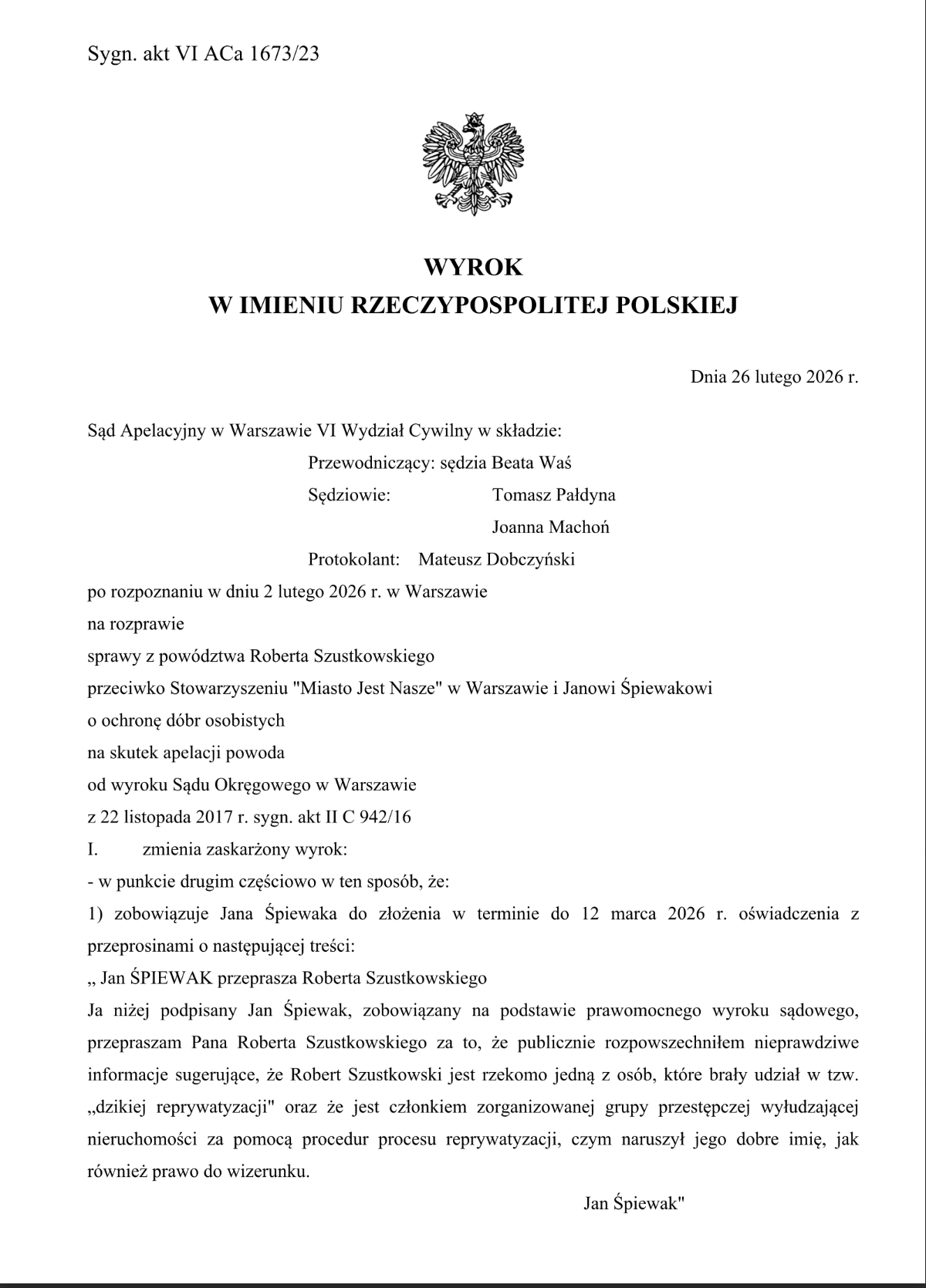
- Final judgment of the Court of Appeal, case ref. VI ACa 1673/23, dated 26 February 2026, ordering Jan Śpiewak to issue an apology to Robert Szustkowski for publicly disseminating false information suggesting that Robert Szustkowski was allegedly one of the persons who took part in the so-called “wild reprivatization” and that he was allegedly a member of an organized criminal group extorting real estate through reprivatization procedures, thereby infringing his good name, as well as his right to his image (Appendix 9). The judgment, in the form of publication of an apology by Jan Śpiewak, was to be executed by 12 March 2026. As of today, Jan Śpiewak has not complied with the judgment.
Unfortunately, despite the above, journalists have continued to repeat false information and defame Robert Szustkowski in various press titles.
- Case against Grzegorz Rzeczkowski and Polityka sp. z o.o. S.K.A. (Regional Court in Warsaw, case ref. II C 491/19 – pending). The Regional Court, in proceedings concerning the protection of personal rights, granted interim relief to Robert Szustkowski until the conclusion of the case. All articles by Grzegorz Rzeczkowski published in Polityka that are the subject of the dispute were supplemented with a statement by Polityka regarding the granting of interim relief with the following wording:
This article is the subject of a dispute in proceedings concerning the protection of personal rights, which are pending before the Regional Court in Warsaw, brought by Robert Szustkowski, who challenges certain of its claims, considering that they infringe his personal rights. This statement is published as interim relief granted by the Court for the duration of the proceedings.
(example – Appendix 10).

- Case against Tomasz Piątek (Regional Court in Warsaw, case ref. II C 486/23) – the Court dismissed the claim despite the final lustration judgment clearing Robert Szustkowski of the allegation of cooperation with WSW; an appeal has been filed against the non-final judgment of the court of first instance.
- Case against Ringier Axel Springer Polska sp. z o.o., case ref. XX C 542/24, concerning the enforcement of the settlement concluded on 26 October 2020.
- Criminal defamation case against Tomasz Piątek (District Court for Warsaw-Mokotów in Warsaw, VIII Criminal Division, case ref. VIII K 357/24).
Criminal case against Tomasz Piątek and Ewa Domżała (case ref. 5 Ds.1025.2018.1) concerning fabrication of evidence. The Court issued a decision discontinuing the proceedings. The reason for discontinuance adopted by the Court was that, since no proceedings are pending against Robert Szustkowski, there are no grounds for the application of Article 235 of the Criminal Code in the criminal case against editor Piątek and E. Domżała concerning fabrication of evidence. However, the Court stated that Robert Szustkowski should pursue his claims through proceedings for the infringement of personal rights, as there are grounds for doing so. More details on this case: WARNING – Tomasz Piątek once again manipulates facts! – Robert Szustkowski
- Case against Ringier Axel Springer Polska sp. z o.o., case ref. I C 1610/24, with a claim for payment of an amount exceeding PLN 54 million. The lawsuit results from the refusal to pay a contractual penalty arising from delay in the performance of the provisions of the Settlement signed by the Publisher on 26 October 2020 with Robert Szustkowski.
Appendices:
Appendix 1 – list of scandals and journalistic speculations
Appendix 2 – examples of infringements of personal rights
Appendix 3 – Piątek’s testimony – court reasoning in the case against RASP
Appendix 4 – the Court on the book “Obcym alfabetem” by Grzegorz Rzeczkowsk
Appendix 5 – correction to the article by Grzegorz Rzeczkowski published in the weekly Polityka
Appendix 7 – apology published in Newsweek Polska
Appendix 8 – apology from the association Miasto Jest Nasze
Appendix 9 – first page of the judgment of the Court of Appeal against Jan Śpiewak
Appendix 10 – sample article containing Polityka’s statement on the granting of interim relief